How I prepared for the MCAT in only a month

The MCAT is a rite of passage to medical school. Everyone takes it. It is a formidable barrier that many spend months or even years preparing to overcome. I prepared for a month.

To give a little background, I didn’t know MD/PhD programs existed until the March before I applied to medical school. As I was preparing to take the GRE so that I could apply to graduate schools that fall, I came across the program as I looked into where I would like to do my PhD. It seemed like a program that would allow me to do all that I hoped to do with my life and over the next month, I solidified my decision to apply.

In the mean time, I took my GRE and my chemistry GRE the month after just in case I ultimately decided to not try for the combined degree. I signed up for the soonest MCAT I could once deciding since I wanted to apply that year but not too soon that I would not have adequate time to study. As I came to my decision in April, my next option was later in May but I had finals and a trip planned before then. Therefore, I opted for the late June test date.

I survived finals and then I took off for a week in San Diego to visit my aunt. I came back on May 20th and the next day I started studying for my June 21st MCAT.

 ~

The Goods

With only a month to prepare and being a poor college student, any prep course was out of the running. As more of an independent studier anyway, I preferred to do it on my own.

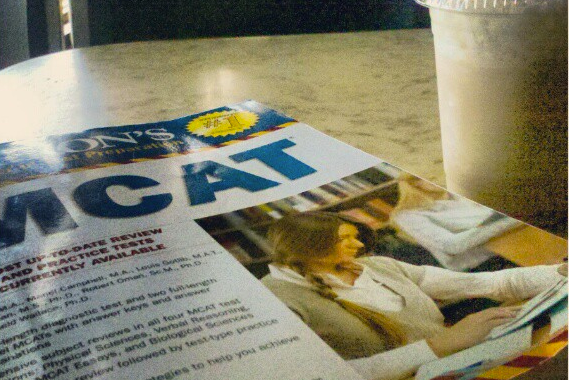
I searched on Amazon for MCAT prep books hoping to find one that was comprehensive and cheap, and I ultimately decided on Barron’s MCAT prep book. Not only did it include study materials for each subject and practice tests but it also came with a CD-ROM of practice tests that mimicked the screen display of the actual exam.

Barron MCAT

~

The Plan

I knew that making a study schedule would help me keep on track and use my month to its greatest potential. Therefore, I split up the time before my test to make sure that I covered everything in my prep book with plenty of time to spare to run through practice exams.

To get through all of the information quickly, I decided to do one subject a day. One day was physics, the next general chemistry, the next verbal, the next organic chemistry, then biology, and finally the essays. While going through each subject, I would do the practice questions pertaining to that subject as a way to gauge my understanding. I took a week off of working in my lab and focused all of my energy toward getting through as much material as possible. While I didn’t quite keep to my goal of a subject per day, I had given myself plenty of leeway to fit everything in.

~

The Grit

After reading and taking notes on all of the information, I then put my focus on doing practice exams. I never did an entire practice exam in one sitting, instead doing a section at a time then grading it and going through the questions that I got wrong. This last part was the most important step. I used the exams to diagnose what areas I needed to work on and then I would do my best to look up as much information about them as necessary until I were comfortable with it. By really trying to figure out why I got a question wrong and how I should look at a similar question the next time, I was able to learn from my mistake before I made the same one on the real exam. I did each exam multiple times to make sure what I was learning was really sticking.

~

The Final Countdown

Over these few weeks, my scores on the physical sciences and biological sciences sections rose quite a bit and I was happy with how well I was doing as I became more familiar with the exam. Nonetheless entering the last week before my exam, I was still not doing as well as I hoped on the verbal. I decided that I needed more practice questions to go through so I caved and purchased The Official MCAT Self-Assessment: Verbal Reasoning. While this is normally an assessment to use prior to studying for the MCAT, I used it as my final practice because it offered me many passages to read and 120 questions to run through and become more familiar with the kinds of questions that will be on the real test.

~

The Calm Before the Storm

I spent the night before my exam not even thinking about science. I left lab early and went to an aunt’s house who lived close to my testing center so that I didn’t have to drive in rush hour traffic for at least an hour in the morning. I hung out with my aunt and uncle as well as my aunt who was visiting from San Diego. We watched a baseball game and relaxed, and I tried to not think about the morning’s exam. I went to bed early so that I was well rested in the morning though nerves made it hard to fall asleep.

~

The Day Has Come

The morning of my exam, I woke up early and ate the largest breakfast I have probably ever eaten. My uncle made me eggs, toast, and bacon. He even put rosemary on the eggs because one of my aunts said that rosemary would help with memory (if it does, this was a little late for it). I also ate the power bar and bananas that I brought for breakfast not realizing that I would have breakfast made for me as well.

I enjoyed a short drive to the testing center, took a sniff of fresh rosemary that my aunt made me bring, not because of its supposed memory boosting ability but because I simply like the smell.

After waiting some time until it was my turn to enter the computer lab, I was scanned with a metal detector and had my fingerprints taken before taking a seat at a computer. Then, for the next five hours or so, my complete focus was on the exam. While we were given 10-minute breaks between sections, I did not stop – I had information in my head and I wanted to get it out. Plus I didn’t feel like just sitting there for 10 minutes at a time with nothing to do.

Everything was going smoothly until the writing section when, despite eating such a large breakfast, all I could think about was how hungry I was and what I wanted to eat when I was done. As someone who normally can get by with little food until dinner, this was rather strange. I tried to ignore those thoughts and finish my writing alas forgetting to save one of my two writing samples before time was up (seriously, no auto save?)

I sped through the last section partly because I was confident in my answers, partly because I wanted food, and left with half my time still remaining. The proctor seemed quite surprised that I was leaving the room because I was done and not just going to the restroom.

After stocking up on food and eating my fill, I entered a sort of loopy tired state. It seems the test had mentally worn me out without my even noticing. What followed was probably the best nap I have ever taken. Ahh, the test was behind me.

Sleeping Cat

~

The Aftermath

After the test, life went on. I continued to work full time in my lab and the time I once spent for studying was redirected toward my personal statements (an ordeal of its own). Finally after a month of anticipation, scores were released. I had my goals set to a perhaps unrealistically high score and yet I was decently satisfied with my score despite a low writing score from forgetting to save. Nonetheless I had my personal statements and my GRE writing score to back up my writing abilities and offset that lower writing score. Ultimately, it worked out. I got accepted. And that’s what matters.

More on the blog: Study tips for the MCAT

This is just the beginning!

If you like my writing, please consider following my blog. There’s a link near the top of the side bar to do so. Also, feel free to like my Facebook page, MD, Phd To Be, and follow me on Twitter, @MDPhDToBe. Any questions, comments, or requests for future blog posts can of course be directed to me from any of these locations or directly emailed to me at mdphdtobe@gmail.com. Thank you for reading!

Featured image source: “Studying” by Steven S. | Flickr | CC BY 2.0

Grades – Will they make or break you?

I was recently asked the following on my ask.fm account:

How important are grades for med school? Can other things make up for not achieving super high grades? I read that you got in with a 3.6 (I thought getting in required gpas near 4.0); what else made you a strong applicant? Not trying to sound rude or anything 🙂

While I could go on and on about GPAs and being a strong medical school applicant, I will limit my response that is nonetheless too long to fit in its original medium to this:

Of course getting good grades is definitely important. It shows that you can be successful over a long period of time in a variety of areas of study.

But there is a fault in looking at GPA alone – it’s variable.

A GPA from one major is not equivalent to a GPA from another major. A GPA from one college is drastically different from the next. If you took a lot of easy courses and got a 4.0 or you took a lot of hard classes and got a 3.7, the 3.7 is probably the better GPA. You can also replace the word “classes” in the previous sentence with the words “major” or “school” and it would be just as applicable. For example, I took a ridiculous amount of hard classes in my major and beyond at a large research institute, so my 3.64 is likely stronger than you think.

BUT if you look at numbers alone, a higher GPA is obviously better. It’s a deceiving measurement. In fact, I’ve heard that some schools only look at GPAs above a certain cut off, but where you fall above that range matters less.

Just to make sure, I checked with my PI today who has sat on many admissions committees for our MD/PhD program. He said that your GPA can break you, but it can’t really make you. So a really high GPA isn’t going to set you drastically above other applicants, but a low one can hurt your chance at admissions.

That being said, he also told me that much more weight is placed on the MCAT because it is the same test wherever you go and lacks the variability of the GPA. So while I had a 3.6ish GPA, I also had a 35 on my MCAT to make up for it.

It is also important to note that while you do need to show academic intelligence to be a strong medical school applicant, you also need to show things like passion, dedication, and a general understanding of what it’s like to be a doctor.

You can do this by being involved. While generally it seems that people have the idea that the more extracurriculars, the better, I’ve in fact heard and believe that being involved in things that you can be highly dedicated to and are passionate about is better than just trying to boost your resume with experiences that are superficial. No, these activities do not necessarily have to relate to science or medicine.

For example, I am particularly passionate about music, and so I was in marching band, pep band, and concert bands in college and even became a leader in these organizations. I could have spread myself out across a bunch of other things but I focused my effort on these because they mattered most to me.

I also am quite dedicated to research (hence why I’m getting a Ph.D. in addition to the M.D. and in fact plan on spending the most of my energy on research in my career). Therefore, I worked in research labs for three years. I had a project of my own in one lab and I was awarded an undergraduate grant and fellowship to do research, which strengthened the experience on my application.

I was also involved in health care as I volunteered at a hospital from age 15 onward so I had 6 years under my belt by the time I applied. Thanks to high school and college keeping me busy plus not wanting to actually become a doctor for most of that time (a long story of its own), I had only accumulated a few hundred hours, but it shows longevity and it shows that I have put in the time to actually experience the kind of work place that I would like to end up working in.

There’s a lot of things that you can do to become a strong medical applicant, but the most important thing is that there is no single definition of a strong medical school applicant. We all have our own strengths and it is those whose strengths most outweigh their weaknesses that are often the strongest candidates. 

~

Featured image source: “Report card 1944” by Phil Jern | Flickr | CC BY 2.0

A year in the life

The new year is often a time of reflection on the previous year and planning for the year to come. As I look back on 2013, it seems to be a lot of endings and new beginnings. Sure there was some bad, but there was also good – life is more exciting with both extremes after all. Here’s some of my experiences from the past year:

Got rejected from many MD/PhD programs

Played volleyball for the first time in an intramural league

Saw my beloved Gophers play an outdoor hockey game in Chicago and visited the city for the first time

Became seriously interested in writing/blogging

Lost my grandmother to cancer

Moved my grandfather out of the house he’d lived in for 58 years

Got accepted to a MD/PhD program

Played in my last pep band gig

Planned a dance (amazingly stressful)

Handed off my undergraduate leadership responsibilities

Completed my UROP research project

GRADUATED FROM COLLEGE

Quit caffeine

Got my first apartment on my own

Cleaned out an entire house

Digitized ~2,500 pictures of my family

Traced my family geneology back to 1090 A.D.

Went swing dancing for the first time

Celebrated 7 years as a hospital volunteer

Dressed up as Cinderella and visited kids at the hospital

Moved my undergrad lab to a new building

Moved by myself to a new state

Started my MD/PhD program

Began drinking coffee again

Made lots of new friends

Started biking regularly

Became a football fan

Ate sushi for the first time

Went to my first scientific meeting

Went home for homecoming

Began shadowing an oncologist

JOINED A THESIS LAB

Got a keyboard and began to play piano again

Surprised my family by turning some writing my grandmother unsuccessfully tried to publish into a self-published book.

Started planning my graduate research project!

Hope 2014 is just as exciting!!!

My third and final rotation

To put it simply, my third rotation was different.

Leaning toward joining my second rotation lab, I picked my third rotation advisor not because of the research focus but because the PI (primary investigator) was a new and enthusiastic professor. Seriously, this PI is one of the most passionate people I have met within the field of science. I had met them on my interview weekend and really enjoyed hearing their take on academia as a recent post doc. As they told me about their research I kept asking “You could apply that to cancer, right?” and they would say, “Yeah, but we’re doing it with muscular dystrophy in the heart” or “Yeah, but we’re looking at the liver.” The scientific area they looked at in the lab (RNA expression/splicing) was a secondary reason why I chose the lab for my last rotation.

I knew I didn’t want to look at the liver or the heart, but I thought I’d try just to see if it sparked my interest outside of cancer in general.

I solidified my decision for doing my third rotation in the lab before I began the second. Then as I began my second rotation, an opportunity to form a collaboration for a grant related to cancer arose and I suggested my third rotation advisor as a collaborator since the techniques used in that lab could be applied to our research. We together wrote our letter of intent for the grant and I began planning a project for me to do during my rotation.

Unlike most students who begin their rotations and are introduced to the lab’s work then given a project, I came in to the rotation declaring my project and was given a side project to get used to the techniques of the lab before applying them to my precious samples. I was given some papers related to the liver work that I was doing but other than my introduction, I never really had a conversation about what I could do with it as a thesis project. I found out at the end that they had that kind of discussion with other rotation students but because I was so set in my ways that there was no need to convince me to switch my interests from cancer and the immune system to the liver.

While I ended up not joining the lab, I had a great time getting to know everyone in the lab (though it was relatively new, there were a lot of undergrads to get to know in addition to the grad student and post doc). I will definitely miss them but I hope to continue to the collaborative project with the lab so I will still get to interact with them. Nonetheless, this rotation re-introduced me to techniques I hadn’t used for many years such as western blots (which I had done in biochemistry lab) and PCR (which I had done in my first undergrad research lab), which was nice to go back to (and made me sort of nostalgic about my first undergrad lab)! So overall, it was quite enjoyable.

I ultimately ended up joining my second rotation lab, but I am glad that I complemented the first chemistry-focused lab developing chemotherapeutic agents and the second immunology lab focused on developing immunotherapies for brain cancer with a lab focused on understanding the RNA expression and splicing changes in disease and development. I ultimately joined the immunology lab, but as I’m researching potential directions to go with my project, I am finding ways to include the three distinct labs in which I did my rotations.

Unlike many students who came in to the program knowing that they wanted to work in a particular area – be it microbiology or biochemistry – or a particular topic – such as non-coding RNA – I came in with a general purpose to have my work relate to cancer therapy. I rotated in both biochemistry and physiology labs that were in quite distinct areas of chemical synthesis and characterization of potential drugs, immunology, and RNA expression. My list of potential research advisors included PIs from all four departments in my specific graduate school. And I went to seminars for all departments as I found some related to my interests in every department.

While I may have a different way of deciding my thesis lab, being much more of a generalist, I think in the long run, it’ll do me well. It’ll help me be a more well-rounded researcher with a broader scope of the implications of my work and the methods available. It’ll also keep things exciting. Instead of being a specialist in a certain scientific level be it biochemistry, microbiology, physiology, etc., I hope to be a specialist in a disease. Pathology is so complex that I feel this is a good perspective to have for my ultimate goal. Throughout the fall, I have made great connections with professors and graduate students during my rotations from many different areas who I can go to for help throughout my journey, and I can’t wait to get started in my permanent lab!

Reflections from my second lab rotation

Each August, my MD/PhD program holds a retreat that includes inviting alumni back to speak to the current students. This year, the theme of one of the alumni’s talks was “serendipity.” Defined as a happy accident, serendipity was a great way for her to describe how she came to her current career as opportunities arose that were best for her but did not fit a conventional career path in medicine. This same term applies to much of my path. It was serendipitous for me to even find out about MD/PhD programs – discovering they existed while looking at grad programs just days before taking the GRE – and apply to my specific school – being encouraged by an e-mail to apply – and it has turned out to be the perfect program for me. And so, I’ve learned to embrace of such pleasant surprises by keeping myself open to change as best I can to see where life will take me.

Today marks the three-month mark of me living in Illinois. It’s crazy to realize that a quarter of a year ago I was making the move excited to start my new life in a new state as an MD/PhD student. Now, it feels like home. In that time, I’ve made many new friends who are grad students like myself, I’ve learned to live on my own, and I’ve adjusted to the responsibilities of being a graduate student. It has been a major change from my comfortable undergrad life in Minnesota where I had family nearby, roommates, and plenty of extracurricular activities to keep me preoccupied.

As I’ve gone through my lab rotations, my research interests have also shifted in a somewhat serendipitous manner. In undergrad, I imagined my research to contribute to improving chemotherapy by developing more targeted small molecules as potential drugs. I rotated first in the one lab that was related to this and that I was interested in before coming to here, and it turned out to not be all of what I wanted in a lab. Fortunately, I found a lab that had not been listed as taking graduate students in the spring when I visited for my interview but was related to cancer therapy – immunotherapy for brain tumors, specifically – and so I took a chance and contacted the PI. It turned out that they were going to be taking rotation students, so I met with them before the school year began and we hit it off! They were actually going to a neuro-oncology symposium at Minnesota, my beloved alma mater, at the end of the first rotation and wanted to have me come with but I had already set up my first rotation so we agreed that I would do my second rotation in the lab and not go to the symposium.

When I met with the PI again near the end of the first rotation, we confirmed that we were going to do whatever we could to be matched in the process of assigning labs. I was going to list the lab as my top choice and they were also going to request me as a student. The next day, we also figured out a way to get me to the symposium in Minnesota by asking my first rotation advisor if it would be alright if I took the last couple days of my rotation to go. They agreed and so I left on the Wednesday night before the symposium and drove 4 hours to Madison where I stayed with one of my best friends who just started a PhD program there. I left the next morning at 4:45 am and made it to Minnesota at 9, just a little late to the symposium but better rested than if I had woken up early enough to be on time for the 7:30 symposium registration.

Being able to go to this symposium was possibly the best opportunity that I’ve had so far in grad school. I learned a lot about neuro-oncology and met many big names in the field. Most importantly, it inspired me as there is a cohort of researchers at Minnesota ranging from basic research to animal and human clinical research devoted to developing immunotherapies for brain tumors who all spoke at the symposium. My knowledge of immunology – and immunotherapy specifically – was limited since I had only superficially been exposed to the topic in my physiology and health psychology classes in undergrad, but I left that symposium really believing that triggering the immune system to attack cancer cells had the potential to be a much more effective mode of therapy than the slash, burn, and poison techniques that are currently used (surgery, radiation, and chemotherapy). It was also a great opportunity because it was homecoming so I was able to stay for the weekend, see many of my good friends, and go to the homecoming festivities for the first time as an alumna.

With my former roommate at the homecoming football game!

As I said in my previous post, “The first rotation is the hardest,” the structure of a lab rotation can vary drastically depending on the lab. While my first lab had me working on a project of my own, my second lab had me essentially just observing. This lab is small with just a graduate student, three undergraduate students, and the PI, so there was less experimental work to observe. This gave me free time during the 5 weeks to research the literature and gain a more in depth understanding of immunotherapy and begin to formulate ideas of my own to pursue.

While there was less lab work to observe, when there was something to observe it was something I had never seen before. As a chemistry major working in a medicinal chemistry lab in undergrad, my work primarily involved analytical chemistry with a little bit of tissue culture. On the other hand, this lab primarily does work with mice and so the first time I had ever worked with mice I ended up doing a little brain surgery to inject cancer cells into their brains, which they were going to live with for a week when we would collect some of their organs for immunohistochemistry. I had never been a fan of dissections (topic of a future post), but I actually enjoyed doing surgeries on mice.

So you may be wondering what interests me so much about the immune system. Well, the immune system is the body’s defense against foreign antigens and so it can be activated to attack bacteria, etc. that are recognized as non-self. Human cells can also be recognized as non-self and can be attacked such as when a person receives an organ donation from a non-compatible donor and the body rejects the organ. To control the immune system and prevent it from attacking the body’s own cells, there are also immune cells that suppress the immune response toward an antigen. Since cancer cells arise from an endogenous (self) cell, they can be missed by the immune system even though they have altered expression of proteins that could distinguish them from normal healthy cells. Additionally, cancers tend to emit signals that promote immune suppression and thus prevent their destruction. I’m hopeful that better understanding this cancer-induced immunosuppression and finding a way of inhibiting it will be able to improve immunotherapies.

You may also be wondering what interests me about brain tumors. Well, one in four cancers that spread throughout the body ends up metastasizing to the brain (about 170,000 will be diagnosed in a year) and the prognosis for these patients is generally poor. For those diagnosed with brain metastases, their life expectancy is usually less than 2 years. Brain cancers are also more difficult to treat because the blood-brain barrier is limiting for delivery of therapies. Therefore, there is an extra challenge in developing therapies, and I am always up for a challenge. 😉 This can be overcome by surgery, which is non-ideal to repeat because it exposes the brain, increases the likelihood of infection, and may not completely remove all cancer cells. As an alternative, immune cells can cross the blood-brain barrier easily, which makes immunotherapy a viable option for treating these tumors.

Though I didn’t need to have a project of my own during my rotation, I was itching to have something to sort of call my own. I finally got my own project started at the end of the rotation that I’m continuing to my third and last rotation in a lab that looks at alterations in RNA splicing during development. I plan to use the RNA analytical techniques of that lab on samples from my second lab. In fact, soon after I began my second rotation, I established a collaboration between the two labs! Therefore whichever one I join, I can work with both PIs because I like both of them as well as their labs.

Just 29 days until I can officially join a lab. Until then, I will need to decide which of these two labs I will be the best for me. Regardless, I should be able to do the science that I want to do, so now it’s just picking my primary lab and advisor.

I guess this is growing up

As Voltaire said, “Uncertainty is an uncomfortable position,” and the transition to medical school or grad school (or both!) often comes with much uncertainty. For many of us, we move away from home, leaving loved ones and everything that we’ve known. If you’re like me, you went to college close to home so the transition then wasn’t too bad, so this is really the first time on your own and this is the first time you’ve felt such a massive shift in your life.

At the same time that we move away and start our new adventure, our undergrad friends get real jobs and start to figure out their lives in our absence. While we struggled to get into school before they started their job search, now they are the ones trying to figure things out  while we are set for the next 4+ years (8+ years for MD/PhD students – I like to call it “putting off getting a real job.”) As we go in different directions with our lives, it can be hard to handle.

But this is not our first rodeo. The same thing happened when we began college as we left our high school friends behind. We made new awesome friends who perhaps shared a major, career interest, extracurricular interest (for me, most of my friends were made through the marching band), or love of alcohol and partying (because, you know, college) and we wondered how we could have ever lived without such great friends in high school. No matter how much we intended on staying in touch with high school friends by skyping and visiting each other on the weekends, we start to drift apart as we become immersed in our new life.

It is a sad fact of life that as we undergo transitions we must give up much of the life that we know and love. Nonetheless, it is something we must all endure as we grow through this life, and in the end it can be for the best. Luckily, some of these friendships can last, but they are often put on the back burner for the time being while many others are removed from the hypothetical stove altogether. When you do see these friends again, it is a wonderful feeling. But while you’re gone you do change in a way that these friends do not and it can make the distance hard especially as you begin to find a new niche in your medical school or graduate school cohort.

Beginning a new program of study, you again wonder how you ever lived your life without these people. Medical students are pretty weird, but we are all a similar kind of weird. It may seem normal to us, but to the general population, obsessively studying, putting in the insanely long hours we do, and being oddly excited about cutting into human bodies comes off as really strange. We’re a sort of masochistic bunch, as we push ourselves and devote so much of our lives to helping others. Luckily, we find solace with our own kind as medical school becomes our sort of refuge.

Grad students are pretty weird as well. Striving to enhance the knowledge of our world, putting in long hours, and barely getting paid. It can be a rather isolating educational experience as you work on your own project that not many others may even understand. It’s cool that you’re the only person in the world who knows that much about what you study, but it is also challenging. Luckily, your peers in grad school are going through the same thing and so within your grad student cohort, you find your people.

Then there’s MD/PhD students. We’re sort of stuck between the two. If anyone really embodied the weirdness of either education path, it would be us. Within our medical school and graduate school cohorts, we find the people that really get us at the moment and add a little certainty to our lives.