The first rotation is the hardest

They say your first lab rotation in graduate school is the hardest – you’re adjusting from undergraduate to graduate student, you’re adjusting to potentially a new school and a new state, you’re adjusting to new people, and you’re adjusting to new research and a new lab. Nonetheless, this is a universal experience: every graduate student in the program before you and all of your peers have gone through the same thing or are currently going through it with you. Depending on the lab that you’re assigned, this experience may slightly vary. Some labs will have you work nearly independently; others will have you follow around a graduate student in the lab.

Though it may be difficult, it is also one of the best times of graduate school because there is less pressure on your productivity while you work on research that is likely not related to your future thesis as you may not even chose that lab as your thesis lab. The emphasis of this time is much more to get to know the lab, the professor, the area of research, and figure out if this is a place that you would like to spend the next five or so years of your life working. If you’ve read my previous post “Picking a thesis lab is a lot like dating,” you hopefully understand how picking a thesis lab pulls at your emotions just like dating. Let’s just say my first rotation came with a rollercoaster of emotions.

From the time that I first looked into research at this school, there was one lab that stood out from the rest in appealing to my research interests. I read some of the recent work of the lab and met with one of the graduate students during my interview weekend since the PI (primary investigator, or professor) was out of town. Over the summer, I looked more into their papers and sent an e-mail to the PI to introduce myself as an incoming MD/PhD student, give a background on my research experience, and explain how the lab’s research fits with my research interests. I asked if they would be willing and able to take a rotation student from my program this fall and if they’d like to meet once I moved to campus.

The PI agreed on meeting and so soon after I made my move, we met to discuss the potential of me rotating in the lab. There was some concern regarding my position as an MD/PhD student because of previous experiences with MD/PhD students trying to rush through their PhD to get to their clinical years. I reassured them that I was there to get a full PhD, that on the spectrum of PhD to MD, I was much more on the PhD side having planned to go that route alone for most of undergrad. Nonetheless, I was warned that PhDs tend to take a little longer in the lab though the publications are often stronger than others. This time frame is perceived to be detracting to MD/PhD students as our education is already so long.

As one goal of the lab is to identify small molecules that have an anticancer effect, my desire to become an oncologist seemed to appeal to the PI. We felt that the first rotation would be best for me to be in the lab since during the second, they’d be getting chemistry students joining the lab (these students don’t rotate, they just have to get to know PIs by going to lab meetings and whatnot then officially join a lab at the end of October). Our rotation assignments are ultimately decided by a committee to best fit everyone’s interests, so the PI helped make sure that we were matched by requesting me as a student in addition to me listing the lab as my first choice.

The lab assignments were released and we were matched! Before I had received my official assignment from our program, the PI had already found out and contacted me late on that Friday afternoon. Within 20 minutes of receiving their e-mail, I was at their office to discuss what I would be doing during my rotation and I spent the weekend reading papers to prepare. I was very excited to get started in the lab!

My assignment began that Monday and I started it by going to 8 am lab meeting before my 8:30 class. I briefly talked to the 5th year graduate student who was supposed to be my mentor and the PI introduced me to the lab. Being that it is a large lab, I didn’t really get to know many other students’ names but at least they got mine.

Following class, I met up with the graduate student and began my safety training. Most of the lab was in one building but three of us were in another a few blocks away so I didn’t really get a chance to meet many others in the lab. There was an older MD/PhD student in the lab who I had talked with over the weekend at our retreat who warned me that social cliques were strong in the lab, so I had to be extra careful to be on everyone’s good side. I was also warned that there was a hint of dislike toward MD/PhD students or at least biochemistry students as everyone but the one MD/PhD student were chemistry grad students. Being separated from most of the lab made it difficult for me to get to know others and work on getting on their good side.

At my first subgroup meeting on the second day of my rotation, I met with my PI, a collaborating vet, my mentor grad student, a post doc, and another grad student who were all working on a similar research topic. There we learned that the post doc had got a new job and would be leaving in the next month. To help with his work, my rotation project was then changed to complement his work in which he synthesized potential prodrugs – so much for spending my weekend reading papers to prepare for my rotation.

This shift in my rotation project took me away from biology to a much more analytical chemistry perspective. In fact, it was similar to my research in undergrad. My mentor graduate student gave me some papers to read about the topic and after that I went to the post doc mostly for help instead of the graduate student. I was okay with this because I was having a difficult time getting to know the student and I was becoming frustrated with having a mentor who did not seem too happy about having to help me. I know that its very important to know and get along with your fellow students but you just get to a point where it’s hard to continue to try. In fact, that was one of the most challenging parts of my rotation. They were a 5th year student and had their thesis to focus on so it’s understandable that they were less receptive to helping a new student who wouldn’t be helping progress their thesis, but it still didn’t make my experience better.

Though it was a large lab, I was incredibly surprised by the amount of attention I received from the PI. I was frequently given papers that they thought were interesting and would be valuable for me to read, and then we would meet and discuss them to make sure I understood their value and talk about how they applied to our ultimate goal. It was through this that I was led in the direction of a possible area of work for my thesis and so by the end of my rotation, I knew what would best benefit the lab and myself as a potential research project. I liked the way this was done so that I wasn’t just told “this is what I would want you to do” but more that I was directed toward that area of research, ultimately coming to it from my own experience in reading papers. I had many friends who did not have much interaction with their PI during their rotation, so I felt fortunate to be able to speak with mine regularly.

As I said, my rotation came with a rollercoaster of emotions. Some of the high points were actually getting assigned to the lab which was of high interest by many students, successfully optimizing an HPLC method for my analysis, and impressing the PI by not only reading the papers they gave me to read but finding others and bringing up what I read in those when we discussed the papers. Nonetheless, with the highs came the lows. As I previously mentioned, I was frustrated with not getting to know many students and having the ones who were supposed to mentor me not being too receptive. In time, I was able to meet more students and had some invite me to lunch but the set-up of the lab made it difficult as it was many small rooms instead of a big open lab so everyone was separated. Another low point was hearing from another MD/PhD first year who was interested in the lab that the PI had told them that they decided their lab didn’t fit with our MD/PhD program. After talking to other people in the group, I was reassured that they wouldn’t be showing interest in me if they thought that being MD/PhD actually would be detrimental my success in their lab.

Ultimately, I left the lab after my five-week rotation with a good impression. I could see myself being highly successful in the lab, so now the real dilemma comes from deciding whether I could be more successful in this lab or one of the other two that I will be rotating in. I told the PI I would be in touch in the following weeks as I begin to experience a new lab because my interest in joining the lab may affect how many new chemistry grad students they take. Whether or not I decide that a large lab full of chemists is the best place for me, I do really like this PI and this research, and I would love to form a collaboration if I choose a different lab so that we can still work together. 🙂

Picking a thesis lab is a lot like dating

The lab where you do your graduate school thesis work is where you will be spending about 5 years of your life (or longer depending on your project, sometimes shorter). Whether you do it faster or slower, it is still many, many years of your life. Even more, this experience will be essential to prepare you for your career and so where you do your thesis really has implications for the rest of your life. It does not necessarily define it, but it sure is a lot better to get into a lab where you will be able to get the most out of the experience so that you can be productive and well-prepared to hit the ground running in your career.

Basically, it’s a pretty big decision. Just as big of a decision as picking a significant other, only you’re on a time frame. In my program, we are required to rotate in labs to get a better feel of them, sort of like casually dating a few people before picking someone to go steady with. Each rotation lasts five weeks. At the end of these 15 weeks, we must then go to a professor and join their lab. Let’s just say, I now understand truly why people say that they’re dating grad school and it’s not just about the time commitment.

Say you see a cute looking guy/gal at a party or in class or somewhere in public…

During our orientation, we had three days where faculty gave talks about their research so that we could figure out whose research interested us. We were just an audience for the professor; they had no idea who any of us were or who out of us were interested in their lab just as you would never know someone was checking you out (unless they’re pretty obvious about it).

…and you find out their name, so naturally, you look them up on Facebook…

Schools generally list their faculty on their websites so you can look them up and read a snippet about their research. Additionally, they often list their notable papers that you can then find online and read more about their research. This gives you background information on their work and helps you figure out if you’re truly interested in their research topic. Depending on how much information they have online, you can find out other things like what kind of awards they’ve received, the size of their lab, and the kind of journals where they tend to publish.

…you think you like what you see and so you decide to make a move…

Not all professors require it (they often mentioned it in their talks), but it is a good idea to send an e-mail to those professors you would like to rotate with to introduce yourself, explain that you’re interested in their work and why you are interested (which is where doing background research about their work can come in handy), and possibly argue why you would be a good addition to their lab. If you would like to be so forward, you can then ask if they would like to meet and discuss the possibility of rotating in their lab and what projects are available for rotation students. It’s kind of like asking someone on a date.

…Wow, they said yes! Now you actually have to go on that date…

So the professor said they would love to meet with you, cool! You meet them in their office (usually) and they try to get to know a little more about you – what your previous research experience has been, what you want your future research to be, why you want to be in their lab (often more in depth about the things you wrote in your e-mail). Then they tell you about their research (which can get lengthy as professors LOVE to talk about their work… I usually set aside an hour or so when I meet with a professor). Perhaps you both really like each other after these discussions and it progresses to actually rotating in their lab, then you get on the topic of rotation projects. Yay!

Since there are so many students in my class and our interests may overlap, just because there is mutual interest between student and professor doesn’t mean that you’ll get to rotate with them. We list our top six preferences for professors and a committee then goes through to optimize our placement so that everyone gets the highest choice possible – say six people list one person as their first choice but that person is only taking one student at a time, five of those people will not be getting their
top choice. If a professor REALLY likes you, they can increase your chances by giving input to the committee that they’d really like to have you as a student.

…You understand that the person may be putting on an act, so you try to find out more about them from people that know them…

Grad students are likely to tell you the honest truth about the lab. They understand what you are going through having gone through it themselves and so they generally are willing to tell you straight up what is good and bad about the lab. Maybe the professor seems really nice when you meet them but has been known to actually scream at his students (true story, glad I found that out before I put him as one of my top choices). Obviously he’s not going to tell you that he does that but the grad students definitely will.

…as you’re not in a steady/exclusive relationship yet, you can go ahead and flirt with other people and you take full advantage of the opportunity…

No matter how much you want to join a particular lab, it is in your best interest to talk to many professors to really find your best fit. Whether their lab becomes one of the three where you rotate or not, they can still be a good connection for possibly being on your thesis committee (a group of professors that oversee your progress and ultimately decide when you can graduate with a PhD), teaching a class that you TA for, or teaching a class that you actually take. You may feel like a player, but it’s okay because the professors are likely talking to more students than they’ll be taking into their lab too.

…the stars align and you start regularly dating a person…

The committee takes the list of six preferences from each student and works their magic to satisfy the students and professors to the best of their abilities (a HUGE challenge). Voila! For the next five weeks you will be in a certain professor’s lab.

…you keep the fire alive in the relationship…

Nothing is set in stone yet, so you need to continually show that you would be a good addition to the lab – a good mate. As a rotation student (and later as a permanent member of a lab), it is important to show interest in the work. The professor/grad students may give you papers to read and discuss with them. You can even go beyond that and find more papers related to those given to you. You also do lab work and try to be as productive as possible. You work long hours to show your dedication. You just generally try to act as a student who will be a good contributor to the professor’s research goals (and if you’re genuinely interested in the lab, all of this just comes naturally!)

…you get to know their friends and hang out with them…

It’s always important to be able to get along with your significant other’s friends and of course have their approval. In grad school, this is important too. You try to get to know the graduate students that are already in the lab to see if you’d get along as coworkers. The social dynamics of the lab can sometimes make or break your experience. These people can potentially help you adjust to the lab and learn the methods related to your work, and potentially collaborate with you on your projects.

…finally, you decide to get serious and become exclusive – you have your match!

After three rotations in different labs, you approach the professor you want to advise you on your thesis work and ask to join their lab. Assuming that they haven’t already had others approach them and so there are still positions available, they may say yes and you then have your thesis lab! Sometimes others get to the professor first and they fill the available spots in their lab so you’re out of luck there. You then approach your second choice. If all three of your rotations are either incompatible with your personality/research interests/work ethic, you may not get into any of your rotation labs. There is an option to do an extra rotation during winter break, but this is a last resort. Ultimately, the program will do its best to get you matched to a lab.

Say the person you ended up with isn’t the best (maybe you didn’t find out everything you should have before making a decision). There is still an option to break it off and go steady with someone else.

I have heard a few cases where students joined a thesis lab and a few months later joined a different lab (even a case where this happened a few years into the thesis.) It’s not optimal as it sets you back but it can be done. In fact it’s better to start over after a little while than be in misery for your whole thesis or risk not being able to complete it.

This is what myself and the rest of my peers are going through this fall. We are currently awaiting the placement for our second rotation. Starting on December 9, we will be able to officially join a lab (happy birthday to me!)

My Nerdy Halloween Costumes

If you’re anything like me, Halloween is just another time to shout to the world, “Hey! I’m a nerd!” (Because it’s not like people can already tell.) It may still not for be nearly two months, but I just thought of an awesome costume today and I’m so excited! Therefore, I would like to share my previous Halloween costumes

Image

2011 – Sexy Scientist

Because being a scientist for Halloween is just a given. I took an old lab coat of my dad’s and altered its size so that it fit well. I decided to wear spandex shorts underneath to make it really seem like the lab coat was a dress. After that it was pretty simple. I took gloves from my lab, put on my lab goggles from undergrad chem lab, and bought a new 500 mL erlenmeyer flask as a prop. I saw a few scientists that year on my way to a Halloween party, but surely none of them were as cool as me. Want to know why? The erlenmeyer flask wasn’t just a prop, I drank out of it! If you do this though, make sure to buy a brand new flask. You can get them pretty cheap on amazon.

~

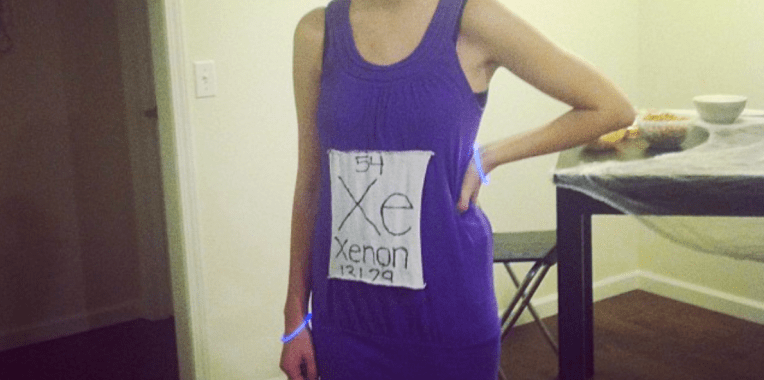
Image2012 – Xenon: The Noble Gas

I wanted something even more different to top my scientist costume. Therefore, I came up with being an element. I picked xenon because when an electric current is ran through it, it emits purple light. I already had shiny purple spandex leggings from Ragstock that my friends had bought me for some reason and I had a long purple tank top, so I had the majority of the outfit good to go. All I had to do after that was use puff paint to write out the periodic symbol on a piece of white fabric and sew it on to the tank top. I also bought a cheap crown from the party section at target since xenon is a “noble” gas. I got purple glow sticks later in the night (not shown) that actually looked like a xenon lamp.

~

Mrs. Frizzle2013 – Mrs. Frizzle

I had a throwback to my youth this year as Mrs. Frizzle from the Magic School Bus. I left my hair wavy and put it up in a bun. I mimicked her space-themed dress with a solar system bodycon dress from Amazon. A lot of people thought I was just a galaxy for Halloween, but I added the school bus to my purse to add to the Magic School Bus theme.

~

Marie CurieAlso 2013 – Marie Curie

With three Halloween gatherings this year, I couldn’t just have one outfit. Thursday I brought back the Xenon costume from 2012, Friday I rocked Mrs. Frizzle, and Saturday I brought back 2011’s Sexy Scientist with a twist – Marie Curie. I used the same lab coat and wore a black dress underneath (Marie Curie is usually just depicted in a black dress but the lab coat was for clarification). I also added my own “radium” by cutting open a couple green glow sticks and transferring the contents to a test tube. It looked really cool but was unfortunately difficult to manage to not spill. Next time, I’ll have to get a cap for the tube so I can put it in my pocket and not have to hold all night.

~

Other nerdy costume ideas that I may eventually rock:

  • Schrodinger’s cat
  • Dark matter

If you have any other cool ideas, let me know!

The Path From High School to Medical School

Everyone takes a different path to medical school, but there is a general guideline to follow to meet medical school requirements. Here, I wish to give you an outline of how to go from high school to medical school and to explain common terms that will surely soon become part of your lingo if they aren’t already.

1. Get in to college. An undergraduate degree is a requirement for medical schools in the United States. Ideally, you should take the ACT or SAT by the end of your junior year or the beginning of your senior year of high school. These are tests that are required to get into undergraduate programs. Which one you need to take is dependent on the school. After taking this test, you will be able to apply in the fall of your senior year. Your high school advisor is a great resource for learning more about the process of applying to college.

2. Go to college. After you are accepted to a school and you graduate from high school, the real fun begins – college! As someone planning on going to medical school, you are defined as a pre-medical student. Pre-medical, or pre-med, refers to a particular track offered by colleges that prepares students for medical school including pre-med coursework, volunteer activities, clinical experience, research, and the application process. Most colleges do not have pre-med as an option for a major or minor. Instead you may pick a major in any field of study. There is no certain major more fitting than others as you can read about in my post: Undergraduate Curriculum.

3. Prepare to apply to Medical School: Once you’ve completed the undergraduate course requirements, volunteered/shadowed in a hospital, and maybe done medical research, you need to take the MCAT. MCAT stands for the Medical College Admission Test, which you should take before you apply; therefore, during or before the spring of your junior year of college if you intend to go straight from undergrad to medical school. It is a standardized test offered by the Association of American Medical Colleges. Over the next few years, this test is transforming from three sections pertaining to physical sciences, biological sciences, and verbal reasoning with a writing section to include a natural/behavioral sciences section including psychological, social, and biological foundations of behavior, as well as the new Critical Analysis and Reasoning Skills sections. The writing section is also disappearing.

4. Actually apply to medical school! When you feel that you will be a competitive applicant for medical school, you apply via the American Medical College Application System, AMCAS for short. The medical schools in Texas have their own system called the Texas Medical & Dental Schools Application Service, TMDSAS for short. The application becomes available in May each year with submission first available in early June. The earlier you apply, the better. After submitting your primary application through either AMCAS or TMDSAS, you will likely receive secondary applications from each school to which you apply. After submitting these applications in a timely manner, you may begin to receive interview invitations, which are required for acceptance to a program.

5. If you don’t get in or don’t feel you’re competitive enough to apply to start right after undergrad, there are options to help you strengthen your application. One of these is a post-baccalaureate program, post bacc for short. If you would like to know more about these kinds of programs, there is a wonderful post on goingtomedschool.com which you can find here: http://www.goingtomedschool.com/2013/06/17/what-is-a-premed-postbac-program/.

Well, that’s the general sequence. I hope that I helped you understand a little bit more about the process of getting to medical school. If you have any more questions, feel free to ask me through my contact form, on my twitter at @MDPhDToBe, or in the comments below. Best of luck!

Adderall abuse in college

I was recently asked a question of my ask.fm account (http://ask.fm/MDPhDToBe) regarding how I feel about Adderall abuse in college. Unfortunately, my response was too long to fit in the space allotted for a response because it is such an important topic to address. Therefore, here are my thoughts:

I highly suggest that you do not abuse Adderall or any other prescription drug, especially to help you do well in college. These drugs are only available by prescription for a reason. If you feel you need to take it for self-diagnosed ADHD or narcolepsy, see your doctor to be diagnosed and get a prescription that way.

If you need more convincing, here’s some reasons why abusing Adderall is a bad idea:

1) Side effects and drug interactions. Adderall has plenty of side effects, some minor, some serious. Overdosing can result in cardiac and/or pulmonary arrest, death, severe and lasting mental effects/defects to name a few. If you abuse Adderall, your tolerance to the drug will likely go down so you will likely take more and more of it, increasing your chance of overdosing. If you overdose and you’re anywhere but near medical professionals, your chance of living is slim. This is an extreme case, but it is always a possibility. Other side effects include anxiety, transient depression, heart palpitations, elevation of blood pressure, Tourette’s syndrome, seizures, stroke, and psychotic episodes or plain old psychosis. The negative effects of taking Adderall are amplified by drug interactions. There are 488 drugs that have drug interactions with Adderall, 36 of those interactions are major. Even the common drugs acetaminophen (found in Tylenol) and ALCOHOL can amplify the negative side effects of Adderall. Receiving a prescription from a doctor is important because they will make sure that you can avoid these detrimental drug interactions.

2) Addiction. Adderall is highly addictive, so much that you will find it difficult to ever study again without it. As I previously mentioned, this can lead to a greater addiction as tolerance is increased which increases your chance of overdosing and it can lead to a whirlwind of addiction to other drugs.

3) THE LAW. THE SALE, POSSESSION, AND USE OF ADDERALL FOR ILLEGITIMATE PURPOSES IS A FELONY. FELONIES ARE ON YOUR RECORD. MEDICAL SCHOOLS, FUTURE EMPLOYERS, ETC. CHECK YOUR LEGAL RECORD. THEY WILL PROBABLY NOT LOOK ON IT TOO KINDLY. PLUS, FELONIES ARE PUNISHABLE BY DEATH OR IMPRISONMENT IN EXCESS OF ONE YEAR. DON’T RISK IT.

4) Violation of honor code. While this isn’t a thing at every school, some schools like Wesleyan University are taking the stance that the use of pharmaceutical study aids, like Ritalin and Adderall by students without a prescription is a violation of the university’s academic honor code.  Many other universities hold a similar prohibition through their non-academic honor codes. It’s not even that you will get caught, but you will then have to live with knowing that your academic success is partially attributed to taking an illicit drug. It’s not fair to your fellow students who are not taking drugs to help them study and it’s not fair to you because of its negative effects on your body and it will likely lead to dissatisfaction with studying without it. If you ever run out of it, you’re screwed.

BOTTOM LINE: DO NOT ABUSE PRESCRIPTION DRUGS. Strive for academic success in an honest way. If you need to help yourself focus on studying, drink coffee. Caffeine is still a drug but it a legal drug that is less potent, less dangerous, and available to all. Even better yet, EXERCISE. Exercise has been shown to boost your mental focus and cognitive performance for any challenging task you face that day. Plenty of us have made it through college without using prescription drugs to help us study, so it can be done without drug abuse.

Related articles:

Adderall: The Most Abused Prescription Drug in America. http://www.huffingtonpost.com/dr-ronald-ricker-and-dr-venus-nicolino/adderall-the-most-abused_b_619549.html

Are study drugs a form of cheating? http://www.huffingtonpost.com/2010/10/13/wesleyan-university-answe_n_761495.html

4 Ways to exercise to boost brain power. http://www.boston.com/dailydose/2013/03/07/ways-exercise-can-boost-your-mental-performance/nI4DA55GaKDZbdrAk9EmiO/story.html


Featured image: Instagram | Hanna Erickson

Getting research experience as an undergraduate/post-bacc student

Research is essential to advance our knowledge of the human body and to develop improved ways of treating diseases. Without the innovation of researchers, we still may be doing things like putting leeches on people to heal them of their illnesses or cutting holes in people’s heads to release “evil spirits” that were believed to be the cause of their ailments. To show your devotion to the medical field as a premed, you can get involved in research so that you can get a better understanding of how it is done and a better appreciation of the hard work that goes into the knowledge doctors use to diagnose and treat their patients.

So how do you actually go about getting involved in a research laboratory? If you go to a large research university like I did, it’s a little easier. You find professors that you’d be interested in working with from the university’s website and contact them asking if they’d be interested in taking on an undergraduate student. Your advisor will also be a good resource to contact for help with this. Expect to at least start off volunteering as putting money into an inexperienced undergraduate isn’t the most logical for someone working hard to maintain grants to fund their lab. Depending on the professor (also called the PI or primary investigator of the lab) they may ask you to take a directed research course to verify that you’ll spend enough time in the lab or they’ll at least expect you to be in the lab for a certain amount of time each week. Often, you’ll be paired with a graduate student or postdoctoral student who will be your mentor. You may just assist the student or once you’re more experienced you will get your own project that they will simply advise you about. If you don’t go to a large research university, you can still contact professors at your nearest university to see if they would be able to take you in their lab.

Also, keep your eyes and ears peeled for professors saying that they are looking for undergraduates for their labs. This is how I managed to land both of my research positions in undergrad. I found out about the first lab I worked in because the professor was a guest lecturer in my freshman genetics course. He began his presentation with talking about the importance of research for undergraduates and said that if any of us wanted experience, his lab was always willing to take more undergraduates. I emailed him the next day and he told me to come in and talk to his lab manager whenever I was ready to start work. I found out about the second lab I worked in from an email the professor had forwarded to the chemistry majors by our advisor that said she was looking for undergraduates. As this lab was in a more convenient location and was much closer to what I wanted to do, I jumped on the opportunity. Nonetheless, if you pick a lab this way, you may not be working on something that you would want to go into (like for me, genetic engineering of livestock, which I helped with in the first lab).

Another option is to apply for a Research Experiences for Undergraduates program, REU for short. These are summer research programs that let you to go to another school for 10 or so weeks to get full time research experience. The best part is that you get paid for it! To find more about these, search for “Research Experiences for Undergraduates” on your favorite university’s website or simply google it to find schools that are offering such programs. They are  highly prestigious programs that are highly competitive, so it is suggested that you apply to quite a few of them!

If you’ve graduated from college, there are still opportunities to get research experience without pursuing an advanced degree. One incredible opportunity that I wish I had known about before I applied to med school is the Post-baccalaureate Intramural Research Training Award (IRTA) offered by the NIH. This program is for college graduates who received their bachelor’s degrees less than two years prior to the date they begin the program who intend to apply to graduate or professional school during their tenure in the program. Essentially, the program consists of working in a primary investigator’s lab at one of the National Institutes of Health facilities. It has rolling admissions with just 10% or so admission rate, but it is a fabulous opportunity to try for! I applied in the late early spring of my senior year in case I didn’t get into medical school and had a PI contact me about working in his lab just a few weeks later. Unfortunately (or fortunately), I had been accepted to an MD/PhD program at that point, so such a backup plan was not needed. There’s a general application on the site, but it will help to contact PIs that you’re interested in working with to help you get into the program!

Surely there’s other places to get research experience such as individual study or at a hospital. When in doubt, your advisor is your best friend and can surely help you land a great research experience!


Featured image: Hanna Erickson