Hanna is a MD/PhD student at the University of Illinois and an aspiring physician scientist who aims to specialize in hepatobiliary cancers. She is also passionate about teaching, leadership, and advocacy. The energy she once used to pep up crowds as a college marching band member is now directed toward exciting and educating others about science and medicine, especially through her tweets at @MDPhDToBe and her blog at www.mdphdtobe.com.
My grandfather, an ex-marine, told me a story today. He said that back in World War II when he was stationed in Hawaii, good friends that he’d spend all of his days with would go up in the air to log experience hours in planes, and sometimes an accident would happen and in a matter of minutes they were gone. Then, of course, all of the men would drink that night to honor their memory.
Well, one day, my grandfather was walking with his parachute over his shoulder along side the pilot to the plane when one of the other men ran up to him saying that they were switched out so that the other guy could get the four hours that he needed. Twenty minutes later, the plane crashed and that guy was gone.
You sure bet my grandfather drank a lot to honor his memory that night.
My grandparents in 1946 – one month after they started dating.
Today, my grandfather had to leave the home that he’s had for almost sixty years just three weeks after losing his wife of 64 years who gave him 3 daughters, 7 grandchildren, and 3 great-grandchildren. It broke my heart. But he said, “I got 64 more years than many of those other guys. I got a family.”
He said that after the men came back from the war, they couldn’t appreciate problems facing society. Everything seemed so trivial to the deaths they saw in the service. They knew that they had close calls themselves and it was something that they never forgot.
We may have never experienced such death, but it is important to remember and honor the lives of any who have lost theirs by appreciating the time that we have.
A couple days ago, I was asked on my ask.fm account, ask.fm/MDPhDToBe, the following question:
“You mentioned that you wanted to go to pharmacy school initially, why? What advice could you give to pre-pharm students? What made you change your mind?”
And my response was:
“I was actually first pre-med at the start of high school, but then decided I wanted to do pharmacy instead during my first summer of volunteering at a hospital because I didn’t think I’d want the extensive patient contact (I was rather shy). I wanted whatever I did to contribute to healthcare and I liked pharmacy’s emphasis on drugs and drug interactions.
When I came to college, I was overwhelmed with the amount of people wanting to do pharmacy, and so I wanted to do something different. Also, it was at this time that I was introduced to research and became fascinated with genetics research and the possibility of designing personalized medicine. And so, I changed to wanting to do research that contributed to the design of drugs – as I still want to. It’s not like I completely decided against pharmacy but rather that I incorporated my interest in pharmacy into another way of contributing to health care.
As for my advice, I’ll tell you what a pharmacist that I shadowed in high school told me. Learn chemistry. Lots and lots of chemistry. In fact, her advice was a major reason that I decided to take AP chemistry in high school, which led to majoring in chemistry in college. Also, if your college has a pharmacy school, look to see if they offer courses for undergraduate students. Mine did and so through it I have taken Introduction to Pharmacy, Applied Medical Terminology, Non-Prescription Medications and Self-Care, and Drugs and the U.S. Healthcare System, which all would be helpful classes for the pre-pharm student. My favorite was definitely Drugs and the U.S. Healthcare System because it was an online forum class that we seriously just read about and discussed issues with pharmaceuticals in the healthcare system and what could be done to fix those issues. It was very stimulating and helped me learn a ton about the pharmaceutical industry and ethical issues that doctors and pharmacists face!”
BUT WAIT! THERE’S MORE! I talked to one of my best friends and fellow lab mate who was just accepted to pharmacy school this year (yay her!) for any advice she would have for a pre-pharmacy student. Here’s her biggest piece of advice:
When deciding which classes to take, make sure to check what classes are required by the pharmacy schools you plan on applying to! Their requirements are not as consistent as medical schools. For example, she only took one semester of biology because our school’s pharmacy school only required that, but most colleges require two semesters, which severely limited her options for schools. Also, some are more picky about which classes will fill their requirements. So have schools in mind when you plan what classes you take in undergrad so that you can make sure that you fulfill ALL of the requirements.
Let’s just call it my worst semester ever. My extensive coursework, work in a research lab, extracurriculars, desire to exercise at the rec center at least 4 days a week, and barely there social life pushed back my sleep to a mere average of 3-4 hours a night. No joke. It even had a hashtag on twitter, #sleeplesssemester. Sure I started drinking espresso straight, using my shot glasses for shots of espresso rather than alcohol, but still I was able to stay up late at night, sleeping on the couch for just 15 minute naps then continuing with my work. Now I try to stay up late, but those 15-minute naps on the couch often turn into hours and when I finally wake up, I realize it’s time to simply go to bed. I miss having those extra hours to be productive while the world slept. This leaves me wondering how can I do it again?
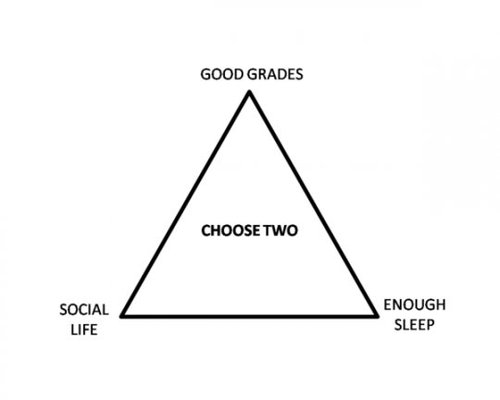
As usually said with the pyramid above, “Welcome to college, you can only pick two.” Prioritizing grades and a social life, it is generally known that the college years are those of likely little sleep, or at least little sleep when it is most appropriate – staying up late to finish school work just to have class early the next day. Coffee, pop, and energy drinks can only help us stay awake for so long. We find sleep when we can in the midst of our lives, but far too often it is sacrificed. Instead, we use our time to master knowledge for our classes, but we forget to master the most important lesson – how to sleep effectively.
Not all sleep is equal; this is easy to forget. When you sleep, you’re not like a battery being charged at a constant rate. How well recharged you feel and how easily you can wake up is dependent on the length you sleep as well as how well you sleep and the consistency of your sleep pattern.
Back during my #sleeplesssemester, I got in a habit of going to bed at 3-4 am and getting up at 6-7 am each day during the week with just a little fluctuation. Now that I work overnight shifts, some nights I sleep 12am-8am, some I sleep 6am-10am, and some I sleep 7:30pm-3:30am (like last night… oops!). This inconsistency makes it hard then to wake up in the morning, which is one of my bigger struggles of the day and makes it very tempting to skip class or go in to work later.
Also back during my #sleeplesssemester, I studied on one couch but I slept on another, but in my new apartment, I now nap on the same couch that I study. It is said to help people fall asleep at night to only use the bed for sleep – no studying or anything else in the bed. Perhaps that can go the other way as well to say ONLY sleep in bed. It may be hard to do when tired and the couch is so convenient, but it helps remove the association that it’s ok to stay asleep on the couch for long periods that could result in 15 minute naps turning into hours.
Sleeping on the couch for so long also gets me into deeper sleep than the 15 minute naps that I intend. After sleeping for hours on the couch and going through the sleep cycle, waking up at some point in it and having to then get ready for bed, climb into bed, and fall asleep again disturbs the sleep cycle making it much less effective. It is as if that time spent sleeping on the couch did nothing to help me feel more rested.
It seems counterproductive to focus on sleep when trying to figure out how to stay up later. But from noticing my sleep habits, I now know of ways that I can try to sleep more efficiently so that I can be able to stay up late when I want to. Only sleeping in my bed, napping on a different piece of furniture than I study, realizing when I need sleep and actually going to bed, trying to wake up at a consistent time each day will all hopefully help me feel more rested and will help me get the time back in my day that I want.
Mastering sleep can begin with acknowledging the faults in your sleep schedule and figuring out how you can fix them. Each person is different and so it may take some trial and error to figure out what works best, but being more aware of your sleep patterns and sleep quality can help improve your sleep efficiency, your energy level, and your overall productivity level. In turn, this can help you reach a little closer to the sleep corner of the triangle without having to sacrifice good grades or a social life! Yes you don’t have to just pick two!
Update 2/5/14: I am now in a combined MD/PhD program and I no longer work random overnight shifts. This previous summer, I went cold turkey on my caffeine addiction and focused on sleeping more each night. While my daily cup of coffee routine has returned as a student (because I originally started drinking coffee simply because I like the taste of coffee), I am sleeping 7-8 hours every night and I haven’t felt so awake in many years! While I have a lot on my plate currently, I have found that getting extra sleep hasn’t affected my ability to get everything done at all, in fact I feel that it has helped immensely!
This past Sunday, we celebrated the life of my grandmother who recently passed away 7 months after being diagnosed with cancer.
I like to tell myself that I knew from the day that she was diagnosed that we would have to face this day, to say goodbye, sooner than I had hoped. It is my way of coping, to remind myself that on the bright side, we knew it was coming so we were able to at least say our goodbyes.
At our open house for her (as she said “there will be no funerals for members of this house!” – referring to her and my grandfather), I had family friends and distant relatives tell me, “I’m sorry for your loss” – I had always known of the phrase as common but never thought much of it.
Suddenly I found it absurd.
This isn’t just my loss – they knew her too – it is their loss as well. It is the world’s loss. Even as an elderly woman, she was involved in a cribbage club, a caregiver’s group, a book club, a bowling league, and kept in touch with other good friends in addition to loving her family. No matter how well any of us knew her, she made an impact on all of our lives and now, she is gone.
Even as a close family member, I shared her with three great-grandchildren, six other grandchildren, her three daughters, her husband, and her cat. While I felt exceptionally close compared to the other grandchildren – living with her for a summer, calling 2-3 times a week at least – I can appreciate everyone else’s love for her as well. If anyone truly deserves to hear “I’m sorry for your loss” it is my grandfather who spent the past 64 years with her and whom she took care of in her final years.
We all lost a great woman and no one should have to tell another “I’m sorry for your loss.” Rather, it is “I’m sorry for our loss” or if it must be specified in any circumstance, “I’m sorry about your grandmother/grandfather/uncle/aunt/mom/dad/sibling/dog/etc.”
From my experience, the possession associated with “I’m sorry for your loss” is not felt as deserved as a family member grieving. Perhaps this denial of possession is to spread the grief and sadness, but I’d like to think of it as wishing to spread the joy of having known such a wonderful person to not think of it as the negative of losing the person, but the gain of having known them.
It is small things like this that we must acknowledge when looking at the world, choosing how to think, and deciding what to say. It’s the difference between a loss and a gain. It’s the difference between keeping something to yourself or sharing it with the world. It’s the difference in perspective.
I never thought I would be so upset about the loss someone who was so mean to me.
In middle school, he made fun of me for being good at school, then tried to get me to give him answers. He put me down about my Lord of the Rings obsession. He was a bully, someone I tried to avoid. As we moved on to high school, I lost most knowledge of him. I think we may have had a class or two together, but even if we did, we didn’t interact. He was a popular jock – a hockey player, perhaps other sports as well – but he was still a relatively smart kid from the little of him I heard. I knew he was the kind that drank and partied, but so was many at my school. We graduated, moved on to college, and he was gone from my world until last fall when I found out he died from a drug overdose.
Later, I found out that he’s had issues with drugs, went to rehab this summer, and had transferred colleges so that he could live at home.
He was 21-years-old. He hadn’t even finished college. He had his whole future ahead of him. As I read the posts on his Facebook wall of people’s memories of him, he came off as a guy with a great personality, a really funny, nice and caring person. It makes me wish that I had got to know him and not let my 7th grade interactions with him affect my idea of him as a person.
He isn’t the first of my graduating class to die, but he is the first to die of a – can I say without seeming heartless – preventable cause, which makes it no better or worse than the other accidental deaths but I can’t shake this off. I can’t help but think what if someone had helped him? What if he had made the conscious decision to fight his addiction? Why did his abuse of drugs start? Why did his rehab not work? Why did his life have to end at such a young age? What can I do to help others so they do not succumb to this same fate? Such questions and more continue to race through my head.
And so I beg of all of you, whether you do drugs or know someone who does drugs, BE SAFE and WATCH OUT FOR EACH OTHER. You may think that you’re consuming a safe amount of the drug, but you’re still putting something into your body that should not be in your body and you don’t know how you’ll react. The human body is essentially a fine-tuned chemical reaction and you are introducing a new reactant that can totally shift the equilibrium past a threshold for the body to function. You don’t know if the drug is more or less pure than the drug that you had last time, so you may think you’re taking a safe dose, but you may not be. The formulation of drugs changes especially when they’re illegal and non-regulated drugs. Or you might just get carried away in the heat of the moment and consume too much. If you have a drug problem, please ask for help. Your loved ones will thank you. No high is worth risking your life. I repeat, NO HIGH IS WORTH RISKING YOUR LIFE.
I’ve always known that drug overdosage is a problem, but I now have a face to put to it. We were never friends, but we were classmates, and now he is someone that I will never forget. RIP.
This is reposted from my old blog, premdphdlife.wordpress.com. Today would have been his 22nd birthday, so I think it’s appropriate to post it again in my new more permanent blog. Thinking of you, bud.



 MD, PhD To Be